
Pietential Leads Wellbeing Risk Intelligence Category, Connecting People’s Wellbeing to Business and Financial Outcomes
Built on six years of science, Pietential pairs with Transcend Applied Wellbeing Risk Intelligence, linking wellbeing
Press Release Disclaimer: This is a press release distributed through the XPR Media network. It has not been independently verified by our newsroom.
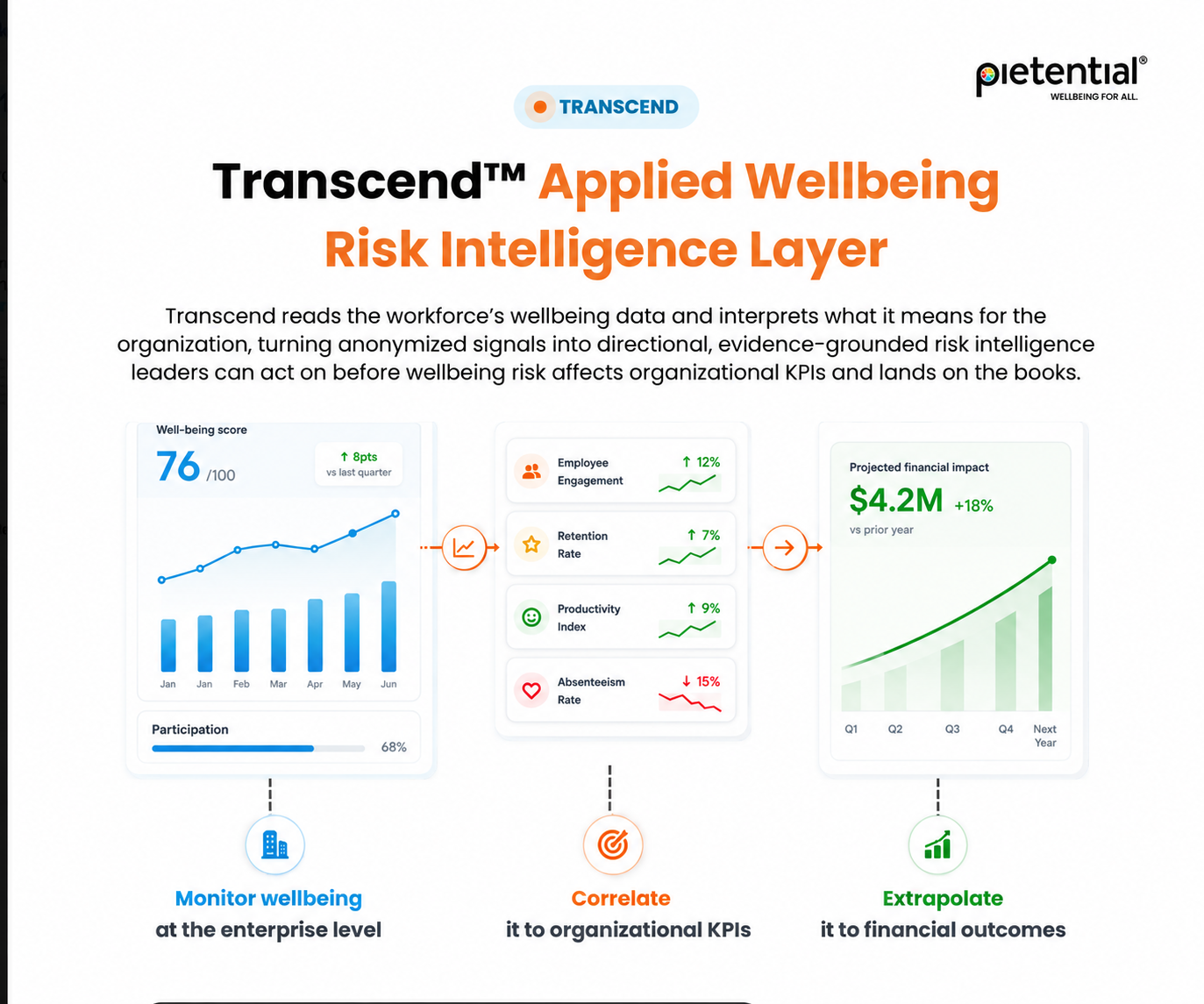

Built on six years of science, Pietential pairs with Transcend Applied Wellbeing Risk Intelligence, linking wellbeing to business and financial outcomes.
PHILADELPHIA, PA, UNITED STATES, October 26, 2026 /EINPresswire.com/ — Pietential® is establishing Wellbeing Risk Intelligence as a new category of organizational intelligence. Building on six years of scientific measurement and technology development in quantifying human wellbeing, the approach connects workforce wellbeing to organizational performance and downstream financial outcomes.
Pietential’s independent, psychometrically validated Wellbeing Intelligence Platform helps individuals and organizations measure, understand, and track whole-person wellbeing. With Transcend™, its Applied Wellbeing Risk Intelligence layer, the platform connects changing wellbeing patterns to the challenges leaders care about, from CHROs, Chief People Officers, and people analytics teams to CEOs, CFOs, and COOs.
The Problem: Wellbeing Investment Without Business Intelligence:
Organizations continue investing heavily in employee wellbeing, mental health benefits, and workplace wellness. According to Business Group on Health’s 2025 Employer Well-being Strategy Survey, 20% of employers planned to expand their well-being offerings, 73% planned to maintain their well-being offerings, and 94% were raising expectations for wellbeing vendors to deliver improved outcomes.
Yet many organizations still lack an independent, objective means of measuring how their people are doing, evaluating investments, and understanding how wellbeing relates to business performance.
The consequences can be substantial. Disengagement, absenteeism, declining productivity, and turnover create downstream financial exposure through lost output, employee replacement costs, operational inefficiencies, and reduced profitability.
“Organizations are investing heavily in wellbeing, but spending money and understanding its impact are two very different things,” said John Starling, Pietential’s founder and CEO. “We’ve spent six years solving the measurement problem. Now we’re connecting that intelligence to the business problems executives are accountable for.
Creating the Wellbeing Risk Intelligence Category:
Pietential is defining Wellbeing Risk Intelligence as a new category of organizational intelligence, built on the systematic measurement, analysis, and interpretation of human wellbeing data to identify emerging organizational risks, examine relationships with business performance, and evaluate potential downstream financial consequences.
The foundation is Pietential’s independently psychometrically validated assessment, measuring whole-person wellbeing across five domains and 20 subdomains.
The category connects people analytics, workforce intelligence, human capital analytics, and enterprise risk management with the human conditions influencing organizational outcomes. Pietential can also be delivered as an employee wellbeing benefit, providing individuals with private wellbeing journeys, a personalized AI companion, and personal growth resources.
Through Transcend™, Pietential applies AI-assisted interpretation, longitudinal analytics, predictive modeling, and conversational intelligence to help organizational leadership monitor wellbeing patterns, correlate them with business KPIs, and extrapolate potential downstream financial consequences.
For example, Transcend can help identify a workforce cohort experiencing declining feelings of safety or belonging, investigate relationships with absenteeism and retention, and model potential financial exposure using organizational data. Executives can explore, in plain conversation, what emerging wellbeing risks may mean in dollars, and where acting in time could make the difference.
This is Applied Wellbeing Risk Intelligence: connecting the human condition to engagement, performance, retention, and the financial outcomes executives are responsible for.
Business Strategy Meets Human Wellbeing:
Pietential’s evolution is led by Starling, who spent over two decades advising companies on growth strategy while also serving as a professional life coach and executive coach. His experience connecting business growth, organizational leadership, and individual human development shaped Pietential’s founding premise: “Everything is downstream of wellbeing.”
“Organizations are made of people, and the wellbeing of those people influences everything an organization hopes to accomplish,” Starling said. “Pietential and its new Applied Wellbeing Risk Intelligence layer, Transcend, make the relationships between human wellbeing, organizational performance, and downstream financial outcomes visible and meaningful.”
Independent Intelligence for Executive Decision-Making:
As an objective, unconflicted measurement and intelligence provider, Pietential helps organizations understand workforce wellbeing and evaluate their investments independently of the vendors selling the interventions.
By combining validated wellbeing measurement with Applied Wellbeing Risk Intelligence, Pietential is defining a new category that recognizes people’s wellbeing as fundamental to enterprise performance and financial outcomes.
About Pietential:
Pietential is an Independent Wellbeing Intelligence Platform pioneering the emerging category of Wellbeing Risk Intelligence. Combining psychometrically validated assessment, longitudinal people analytics, population benchmarking, and Transcend™ Applied Wellbeing Risk Intelligence, Pietential connects human wellbeing with engagement, performance, retention, and downstream financial outcomes.
Serving individuals, businesses, institutions, nonprofits, and NGOs, its mission is Wellbeing for All.
Learn more at https://pietential.com.
Pratheepa Kannan
Pietential
+1 215-770-5464
pratheepa@pietential.com
Legal Disclaimer:
EIN Presswire provides this news content “as is” without warranty of any kind. We do not accept any responsibility or liability
for the accuracy, content, images, videos, licenses, completeness, legality, or reliability of the information contained in this
article. If you have any complaints or copyright issues related to this article, kindly contact the author above.

Media gallery
